
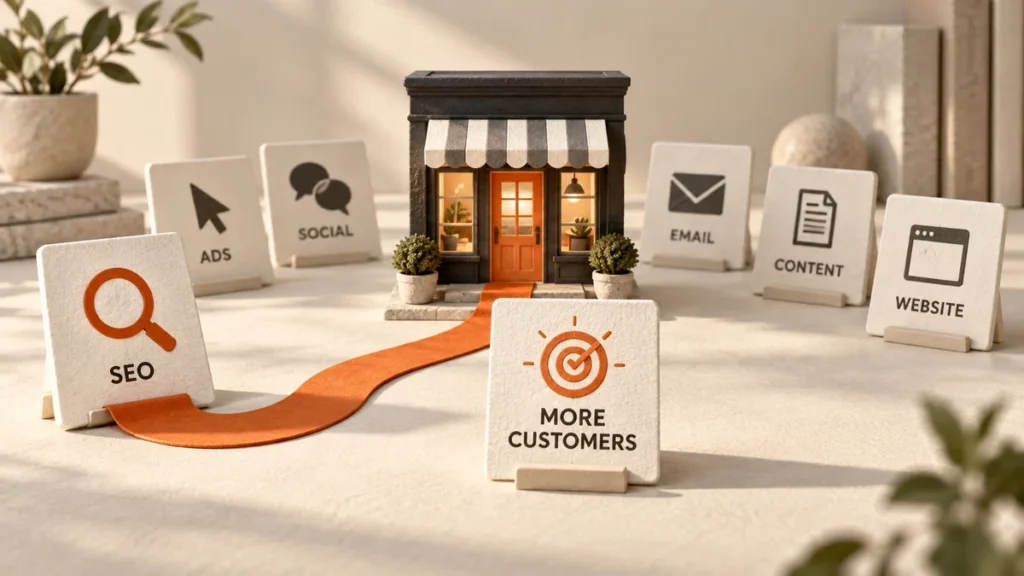
Not All Digital Marketing Services Are the Same
When you start working with a digital marketing agency or freelancer, they’re not all offering the same thing. One person specializes in paid ads. Another focuses on getting you ranked on Google. A third focuses on email marketing. Understanding these differences matters because you don’t want to hire an email marketing expert to run your Google Ads.
This guide breaks down what different digital marketing services actually do. Who needs each one. And what kind of results to expect.
Google Ads Management
Google Ads is paid search advertising. When someone searches for something related to your business, your ad shows up. You only pay when someone clicks your ad. It’s immediate traffic to your website.
A Google Ads specialist manages your campaigns. They research keywords. They write ad copy. They manage your budget. They optimize everything to lower what you pay per click. They track which ads actually convert to customers. They’re constantly testing and improving to get you better results.
You need Google Ads when you want immediate leads and traffic. Ads work fast. You can be getting clicks within days. The downside is you’re paying for every click. Expect to spend at least $500-1,000 per month for decent results. Give ads 4-6 weeks to optimize before judging them. The ROI depends on your industry and competition. Some businesses see 2:1 ROI. Others see 10:1. Track your numbers to know what yours is.
Search Engine Optimization (SEO)
SEO is getting your website to rank on Google’s organic search results. No paid ads. Just free traffic from people searching. When someone searches for what you offer, you show up at the top.
An SEO specialist improves your website so Google likes it and ranks it higher. They research the keywords your customers actually search for. They optimize your website content for those keywords. They build backlinks from other websites to yours. They fix technical issues on your site. They basically convince Google that your site is the best answer to someone’s search.
You need SEO when you want long-term sustainable traffic. SEO doesn’t cost money every month like ads do. But it takes time. Expect 3-6 months before you see real results. After six months of good SEO work, you should rank for medium-difficulty keywords and see traffic increase by 20-50 percent. High-volume keywords take longer. The upside is once you’re ranking, the traffic keeps coming even if you stop paying.
Local SEO
Local SEO is getting your business to show up when people in your area search for what you offer. When someone searches “plumber near me” or “dentist in Portland,” you want your business to show up.
A local SEO specialist optimizes your Google Business Profile, the listing that shows up in Google Maps. They get reviews from your customers. They create content about the neighborhoods you serve. They build local citations, which are mentions of your business on local websites. They basically tell Google that you’re a local authority in your area.
You need local SEO if you serve customers in a specific city or region. Dentists, plumbers, lawyers, salons, contractors. Anyone local. Local SEO works faster than regular SEO. Expect results in 1-3 months. Reviews matter way more in local SEO than they do in regular SEO. Encourage your customers to leave reviews.
Social Media Marketing
Social media marketing means posting on platforms like Facebook, Instagram, LinkedIn, or TikTok to build an audience and engage with people.
A social media specialist creates content ideas. They write posts. They post on schedule. They respond to comments and messages. They build your following. They might run ads on social media. They track engagement and growth. They basically make you look good on social media.
You need social media when you want to build brand awareness and relationships. Social media rarely directly generates sales for most businesses. But it keeps you top of mind. It builds trust. People see you as a person, not just a company. The key is posting value, not just selling. Expect 3-6 months to build an engaged audience. Don’t expect overnight results.
Email Marketing
Email marketing is sending messages to a list of people who signed up to hear from you.
An email marketing specialist builds your email list by offering something valuable in exchange for email addresses. They create campaigns and writes copy. They sends emails on schedule. They tracks opens and clicks. They segments your list so different customers get different messages based on their behavior. They automates sequences so once someone signs up, they get a series of helpful emails automatically.
You need email marketing when you have customers who buy repeatedly or an audience that wants to hear from you. Email has the highest ROI of any digital marketing channel. The average is $40 back for every dollar spent. The catch is it only works if people actually want your emails. Give them a reason to sign up. A discount. A guide. Something valuable.
Content Marketing
Content marketing means creating valuable content that attracts and keeps customers. Blog posts. Guides. Videos. Podcasts. Whitepapers. Content published on your website and social media.
A content strategist researches what topics your customers actually care about. They create a plan for what content to make. They manage the content production. They make sure content actually ranks on Google and brings traffic.
You need content marketing when you want to build authority and prove you know your industry. Content works slower than ads but it builds trust faster. Content ranks on Google over time so the traffic compounds. Expect 6+ months for content marketing to show real ROI. But once it works, you have assets that keep generating traffic and leads for years.
Pay-Per-Click (PPC) Advertising
PPC includes Google Ads, Facebook ads, LinkedIn ads, and any platform where you pay per click or per action someone takes.
A PPC specialist creates ads. They targets the right audience based on what you know about your customers. They sets budgets and bids. They optimizes everything to get more conversions at lower cost. They tests different ad copy to see what works. They improves click-through rates and conversion rates.
You need PPC when you want fast traffic and you don’t want to wait for SEO to work. PPC is the opposite of SEO. Fast results but you stop getting traffic when you stop paying. Use PPC to test if a market actually works before committing to long-term strategies. Expect to spend $500-5,000 per month for real results depending on your market.
Conversion Rate Optimization (CRO)
CRO is improving your website to turn more visitors into customers without getting more traffic.
A CRO specialist tests different versions of your website. Different headlines. Different buttons. Different page layouts. They measures which version converts better. They implements the winner. They keeps testing and improving.
You need CRO when you’re getting website traffic but not enough conversions. Maybe you get 100 visitors but only one becomes a customer. CRO can double or triple your conversions without getting more traffic. This is often cheaper than getting more traffic. Test one element at a time. Give each test 2-4 weeks of data before deciding.
Web Design and Development
Web design and development is building or redesigning your website.
A web designer or developer creates a website that looks good, loads fast, and works on mobile. They might use WordPress, Shopify, custom code, or other platforms. They set up navigation. They create forms for leads. They integrate tools. They basically build your online presence.
You need good web design when your current site doesn’t work. It’s slow. It looks outdated. It doesn’t work on mobile. It has broken links. A good website is foundation for everything else. You can’t run ads to a bad website. Don’t cheap out here. A professional website costs $2,000-10,000 depending on complexity.
Analytics and Reporting
Analytics means measuring what your marketing is actually doing.
An analytics specialist sets up Google Analytics 4 to track visitors. They track conversions so you know which channels bring customers. They connect tools so all your data flows together. They creates reports that show what’s working and what’s not. They identifies problems like high bounce rates or poor conversion rates.
You need analytics when you’re spending money on marketing but don’t know if it’s working. Analytics turns guessing into facts. You can’t improve what you don’t measure. Set up Google Analytics 4 first. It’s free and essential.
Video Marketing
Video marketing means creating video content and ads.
A video marketing specialist writes scripts. They shoot video. They edits it. They distributes it to platforms like YouTube and Facebook. Videos can be ads or educational content on your website.
You need video marketing when your audience responds to video. Some industries use video heavily. Others don’t. Video is growing. YouTube is the second largest search engine after Google. Video ads convert well. The downside is video production costs more than text or images.
Marketing Automation
Marketing automation is using software to automatically send messages based on what customers do.
A marketing automation specialist sets up workflows. When a customer takes an action, automatically something happens. Someone subscribes to your email list, they automatically get a welcome email. Someone abandons their shopping cart, they automatically get reminded. Follow-up tasks create automatically. Leads qualify themselves.
You need marketing automation when you have a complex customer journey or lots of leads to manage. Automation saves time and keeps leads engaged without you manually doing everything. It’s more advanced than basic email marketing.
Common Questions About Digital Marketing Services
What are the main types of digital marketing services?
The main types are Google Ads, SEO, local SEO, social media marketing, email marketing, content marketing, PPC advertising, conversion rate optimization, web design, analytics, video marketing, and marketing automation. Each focuses on a different channel or goal. Most businesses don’t need all of them. Pick the services that directly move you toward your business goal.
How do I know which digital marketing service I need?
Start with your goal. Do you want immediate leads? Try Google Ads or PPC. Want long-term free traffic? Try SEO or content marketing. Want to build relationships and stay top of mind? Try social media or email. Want to improve the traffic you already get? Try CRO. Most businesses benefit from combining 2-3 services instead of using just one.
What's the difference between SEO and Google Ads?
SEO gets you free organic traffic from Google search results but takes 3-6 months. Google Ads gets you paid traffic immediately but costs money every month. SEO builds long-term. Ads stop when you stop paying. Use both for maximum visibility in Google search.
Do I need all digital marketing services?
No. Most small businesses succeed with 2-3 focused services. Spread yourself thin across ten services and you’ll be mediocre at everything. Better to be great at one or two things. Pick services that fit your business and budget. Add more only when your first services are working.
How much do digital marketing services cost?
It varies. Google Ads needs at least $500-1,000 per month to work. SEO typically costs $1,000-3,000 per month. Social media management is $500-2,000 per month. Email marketing setup is $500-1,000. Every service has different pricing. Get proposals from multiple providers and compare value, not just cost.
Start With Your Goal, Not Your Tools
Digital marketing has a lot of services. But you don’t need them all. You need the ones that actually move you toward your goal.
Start with one service. Get really good at it. Track the results. Then add another. This is faster than trying to do everything at once and doing nothing well.