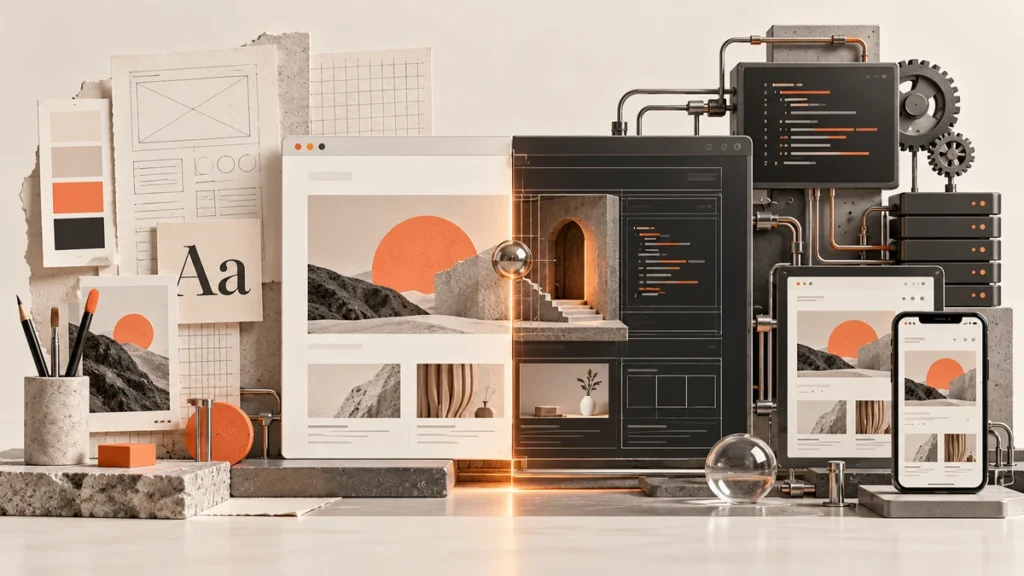
Website design and website development are often used as if they mean the same thing. They are connected, but they involve different parts of building a website.
Design focuses on how a website looks and how people use it. Development focuses on how the website works behind the scenes.
Understanding the difference can help you choose the right support for your business, and this small business website checklist can help you review the wider requirements.
What Is Website Design?
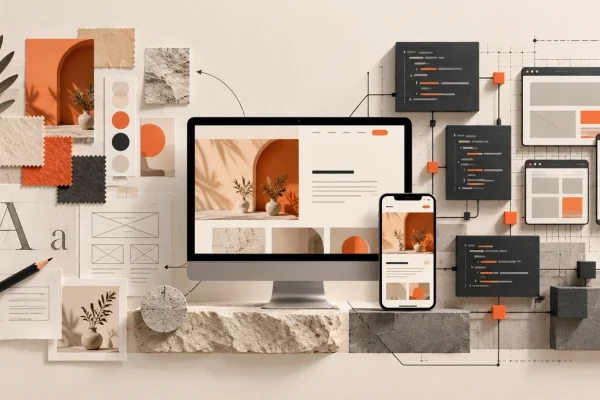
Website design covers the visual and user-facing parts of a website.
This may include:
Page layouts
Colours
Fonts
Images
Buttons
Navigation
Spacing
Mobile layouts
User experience
A website designer decides how information should be arranged and how visitors should move from one section to another.
Good design is not only about making a website attractive. It should also make the business easy to understand.
For example, a well-designed homepage should help visitors quickly answer:
What does this business offer?
Is it suitable for me?
Why should I trust it?
What should I do next?
What Is Website Development?
Website development is the technical work that makes a website function.
It may include:
Building page structures
Writing or managing code
Setting up forms
Connecting tools and integrations
Creating custom functions
Managing databases
Improving performance
Setting up security
Making the website responsive
A developer turns the approved design into a working website.
They also make sure that buttons, forms, menus, pages, and other features work properly across different devices.
The Difference Between Design and Development
The simplest difference is this:
Website design focuses on appearance and user experience.
Website development focuses on functionality and technical performance.
Imagine opening a restaurant.
The design is the layout, lighting, furniture, menu design, and the way customers move through the space.
The development is the kitchen, plumbing, electrical system, ordering process, and equipment that allow the restaurant to operate.
Both are important. A restaurant can look excellent but still fail if the kitchen does not work. The same is true for a website.
Can a Business Use Design Without Development?
Not usually.
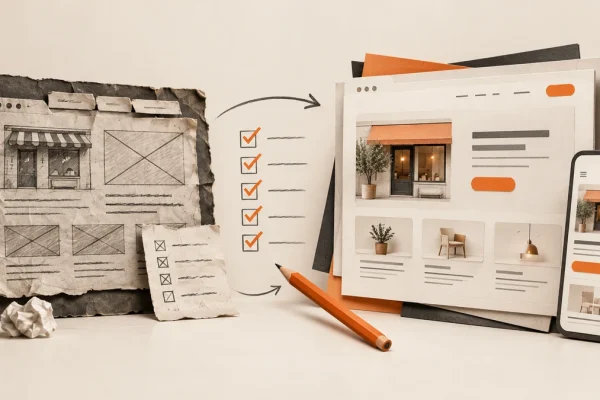
A design file or wireframe is not a functioning website. It shows how the website should look, but it still needs to be built.
Some website builders provide templates that combine basic design and development. They can be useful for simple websites, but they may offer less flexibility when a business needs custom features or a different user experience.
Can a Business Use Development Without Design?
Technically, yes, but the result may be difficult to use.
A website can function correctly and still have:
Confusing navigation
Poor spacing
Weak visual hierarchy
Difficult-to-read text
Unclear calls to action
A poor mobile experience
Development makes a website work. Design helps people use it comfortably and confidently.
What Does a Small Business Usually Need?
Most small businesses need both website design and website development, but the right approach may depend on whether they choose a custom website or template website.
The design should reflect the business, audience, services, and goals. The development should make sure the website is fast, secure, responsive, and easy to manage.
You may need more design support when:
- Your current website looks outdated
- Your branding has changed
- Visitors cannot find important information
- Your pages feel crowded
- Your website does not look trustworthy
You may need more development support when:
- Your forms are not working
- Your website is slow
- You need custom functionality
- Your website has technical problems
- You need integrations with other tools
- Your website does not work properly on mobile
Should You Hire One Person or a Full Team?
That depends on the project.
A freelancer may be suitable for a small, straightforward website. A team may be more appropriate when the project involves strategy, copywriting, design, development, SEO, integrations, and ongoing support.
The important point is to understand what is included before the project begins.
Ask:
Who is responsible for the design?
Who will build the website?
Who writes the content?
Is SEO included?
Who manages the technical setup?
What happens after launch?
How Design and Development Affect SEO
SEO is connected to both design and development.
Design affects:
Content structure
Readability
Navigation
User experience
Internal linking
Mobile usability
Development affects:
Page speed
Responsive behaviour
Technical structure
Crawlability
Security
Redirects
Indexing
A website can have excellent content but still perform poorly if it is difficult to use or technically unreliable.
Final Answer
Website design and website development are different parts of the same project.
Design determines how the website looks and how visitors interact with it. Development makes the website function correctly.
For most small businesses, the best result comes from treating both as part of one connected process. The website should look professional, explain the business clearly, work properly, and make it easy for visitors to take the next step.
Frequently Asked Questions
Is website design the same as website development?
No. Website design focuses on appearance and user experience. Website development focuses on the technical structure and functionality.
Which is more important, design or development?
Neither is more important. A website needs both a clear design and reliable development to work well.
Can one company handle website design and development?
Yes. Many website agencies provide both services as part of one project. This can make communication and project management easier.
Does website design affect SEO?
Yes. Design affects navigation, readability, mobile usability, content structure, and user experience, all of which can support a stronger website.
Looking for Website Design and Development Support?
Your website needs both a clear design and reliable development to work properly. Explore our Website Development Service to create a website that looks professional, works smoothly, and makes it easier for visitors to contact your business.